Article reading time
The worst Christmas hampers in the Netherlands (and how to do it right)
Every year, thousands of Christmas gift baskets end up on Marktplaats. From karaoke sets to discount codes for shops nobody has ever heard of. We review the patterns - and show how it can be done better.
Eight million Dutch people receive a Christmas hamper every year. And every year, thousands of those hampers appear on Marktplaats - sometimes on the very same evening. Not because people are ungrateful. But because many Christmas hampers simply do not match what people want.
RTL Nieuws already wrote about it in 2024: Christmas hampers are being "massively offered" on second-hand platforms. From branded bags to karaoke sets. On TikTok, employees now openly share what is in their hamper. Sometimes proud, sometimes devastating, and often it goes viral.
It is entertaining to watch. It is less entertaining if it is your company that sent such a hamper…
The Marktplaats effect
The pattern is the same every year, and you see it happen every year, especially with large companies. A company buys the same gift for hundreds or thousands of employees. The intention is good, the budget is there, but the gift does not suit everyone (by far). And then they appear: dozens of identical listings on Marktplaats, sometimes just a few hours after the Christmas drinks.
A gift that is fantastic for one person is useless for another. And if you buy the same thing for hundreds of people, that is inevitable. That is a shame - not only of the money, but also of the gesture.
Four patterns of a bad Christmas hamper
After a few years of reporting and now an entire library of TikTok videos, patterns are emerging. These are four that we often see recurring:
The "everyone the same" hamper. 200 people, one taste. The chance that you know exactly what 200 different people like is virtually zero. You make one part happy, one part politely grateful, and one part opens it, looks inside, and puts it away. Or worse: meat products in a team that also includes vegetarians. Or a bottle of wine for someone who does not drink. It is not even carelessness - it is the result of a system that leaves no room for individual differences.
The "we had to find something cheap" hamper. Everyone understands that there is a budget. But the recipient feels the difference between "we really thought about it within our budget" and "we had to find something under ten euros." For example, a few years ago, employees of De Bijenkorf received a single Christmas bauble from their own collection, some of which did not even arrive intact at the recipients' homes. And after an intense Covid year, healthcare workers at a hospital received a hat and scarf with the hospital logo. As a result, the appreciation was not really felt, and that is a shame. Because it is not about the amount - it is about whether it feels like a gesture or like an obligation.
The "promotional item as a gift" hamper. A mug with a company logo, an umbrella with a company name, a thermos flask with a tagline. It was already clear from the example above: it usually does not come across as genuinely warm and sincere. The recipient feels that. And besides, people do not always want to bring their work into their belongings like water bottles or tea cups.
The "edible but not special" hamper. The standard box of chocolates and bottle of wine. There is nothing wrong with it, but there is also nothing special about it. It is the gift equivalent of "fine." It evokes exactly the reaction you expect: "ah, thank you." But really making an impression, it does not do that. And again, it is highly dependent on the recipient's taste whether they will even find it fine. Someone who does not like chocolate or prefers savory will immediately discard this gift or pass it on to someone else.
What does make a Christmas hamper good?
The common thread through all the bad examples: the gift does not suit the recipient. It is chosen from the perspective of the giver, not from the recipient. The solution is not to spend more money or choose a more expensive hamper. The solution is to leave the choice to the recipient.
Three principles that work:
It suits the recipient, not the giver. This can be done by offering freedom of choice, by choosing products that work universally (think of the categories from our always-good guide), or by choosing experiences instead of things.
It feels like a gesture, not an obligation. A personal card with it. A video message. But especially a message that shows someone has thought about it. That does not have to be long - three sentences are often enough.
It does not end up on Marktplaats. The ultimate test. If you wonder whether the recipient will resell this, choose something else. Or better yet: let the recipient choose for themselves, then you can be sure it stays with them.
The easiest way to do it right
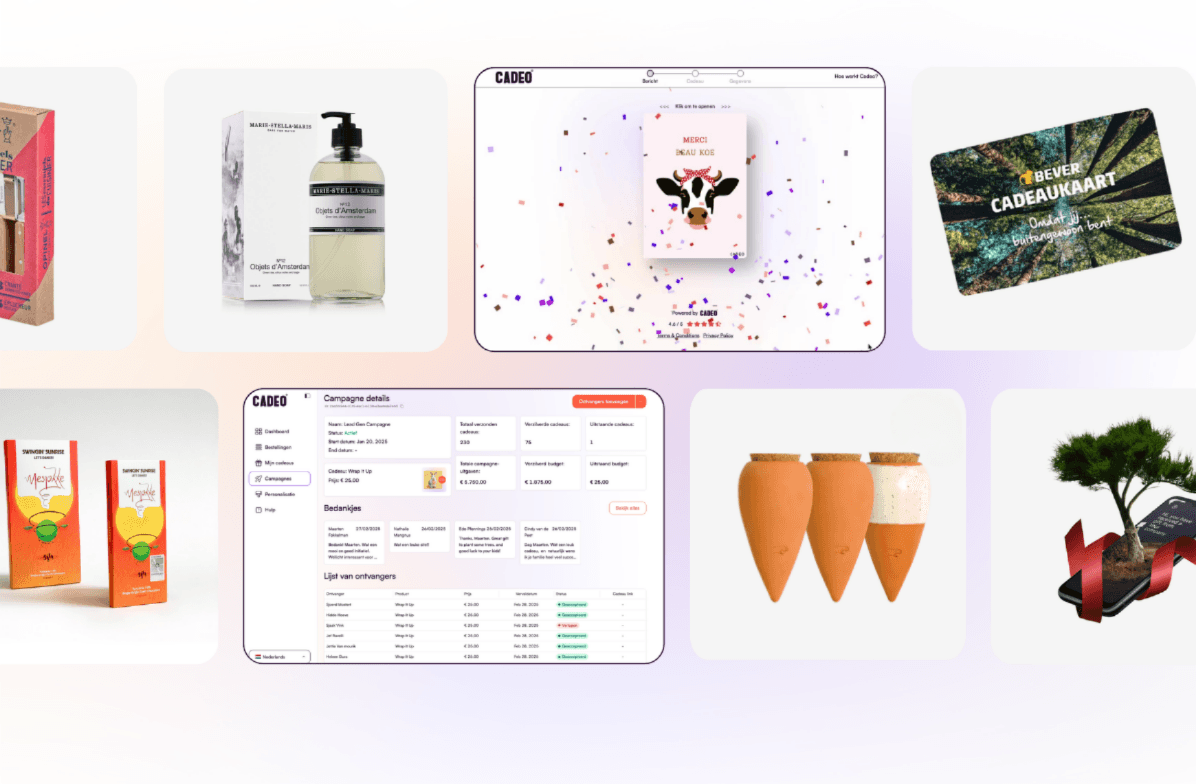
With a choice gift via Cadeo, the recipient chooses for themselves from 1,200+ products - from sustainable design products and local brands to outings and experiences. Redemption rate of 95%. No minimum purchase, no long-term contract, and you only pay for gifts that are actually redeemed.
The Christmas hamper on Marktplaats is a solved problem. You only have to leave the choice to the recipient.
Schedule an introduction and let the mug with logo retire.
Want to do gifting right as well?
Contact us now to see how we can help you with a tailored solution.


