Article reading time
The psychology behind the perfect gift
Givers think they know what the recipient wants. Science shows that is almost never the case. This is what we know about the psychology of gift-giving - and why freedom of choice works so well.

Every year, Dutch companies spend millions on corporate gifts. And every year, research shows that a large portion of those gifts is not appreciated in the way the giver had hoped. Not because the intention is wrong, but because there is a fundamental flaw in how we as humans think about gifts.
Science now has quite a bit to say about this. And it is actually quite useful to dive into. Because it is simply a waste to spend money year after year on gifts that no one remembers or appreciates. If you are going to do it, do it right!
The intention gap
Behavioral scientists at Yale call it the intention gap: the difference between what the giver thinks the recipient wants and what the recipient actually appreciates. In their Behavioral Scientist's Guide to Gift-Giving (2022), they show that this gap is structural - not incidental.
Givers have a blind spot. They think they know exactly what the recipient wants - and then choose something that matches their own taste. It feels logical in the moment, but it is a form of projection. You choose what you like and hope the other person feels the same way.
In a business context, that problem is even bigger. You rarely know your colleagues, clients, or relations well enough to guess their personal preference. And yet we pretend we do - because the alternative (admitting that you do not know) feels uncomfortable.
Self-determination theory: why choosing feels better
In 1985, psychologists Edward Deci and Richard Ryan published their self-determination theory: humans have three basic psychological needs - autonomy, competence, and relatedness. Autonomy, the feeling that you are allowed to make your own choices, is perhaps the most underestimated when it comes to giving and receiving gifts.
Because a gift that you have chosen yourself feels fundamentally different from something that has been decided for you. It is not imposed; it is yours. Recent research in Frontiers in Psychology (2023) confirms this: gifts that are experienced as supporting autonomy evoke significantly more gratitude in the recipient. It is not so much about the value of the gift, but about the extent to which the recipient feels their preference has been taken into account.
The paradox of choice: why unlimited choice does not work
Now you might think: if choosing works so well, just give cash. Or a generic gift card. Maximum freedom, maximum appreciation. Right?
Not quite. In 2004, psychologist Barry Schwartz described the paradox of choice: too much choice is counterproductive. The famous jam experiment by Iyengar and Lepper illustrates this well - when customers in a supermarket could choose from 24 types of jam, only 3% actually bought a jar. With 6 options, that rose to 30%. More choice, less action.
The same principle applies to a generic gift card. Thousands or millions of products to choose from - that does not feel like freedom, but like homework. People become insecure, postpone their choice, or are less satisfied afterwards. The result: in the Netherlands, an estimated 15 to 20% of all received gift cards are never redeemed. Such a waste!
The sweet spot: curated freedom of choice
The solution lies in the middle. You do not want to decide everything for the recipient, because that results in too little experienced autonomy. But you also do not want to offer unlimited choice, because that causes choice anxiety. What then? Offering a curated selection from which the recipient can choose.
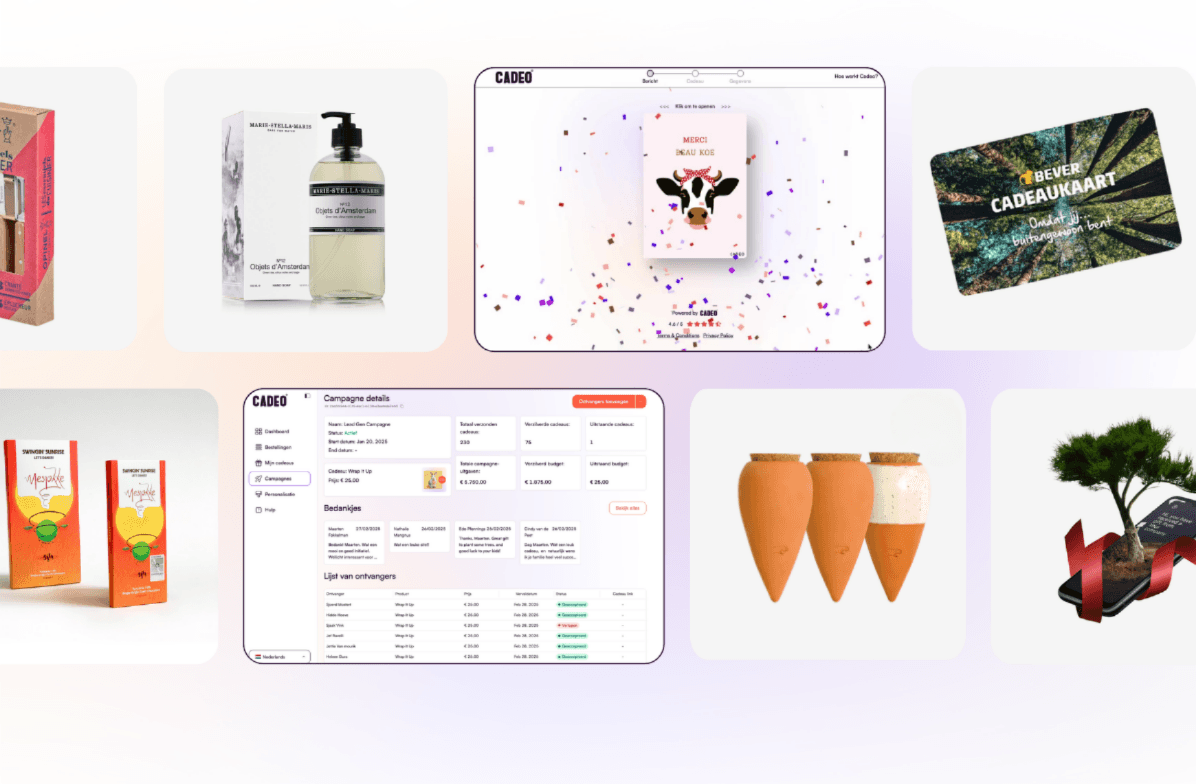
At Cadeo, it works like this: the giver sets up the gift - the budget, the message, optionally the corporate identity - and the recipient chooses a product themselves from the selection portal. Both parties contribute. It feels personal because the giver put effort into it, and it is appreciated because the recipient makes the final choice.
In total, the range contains more than 1,200 products: from physical gifts and experiences to gift cards and donations. But you always give a gift in a certain price category, and per category there are on average about 130 options. Enough to find something that suits you, without getting lost. The redemption rate of 95% confirms that it works.
What this means in practice
When you give a gift to your team, your clients, or anyone else, there are three things that psychology teaches us:
Let the recipient choose. Not out of politeness, but because it demonstrably works better. It might sound impersonal, but it is actually the opposite. The appreciation is higher, the gift is actually used, and the risk of it ending up on secondhand marketplaces is virtually zero.
Provide direction, not an open field. A curated selection works better than a generic gift card. It shows that thought has gone into it, without you completely taking over the choice.
Make it extra personal. Add a message, your own branding, a card. Small additions that make the difference between a transaction and a gesture.
Schedule an introduction and discover how a choice gift through Cadeo works.
Want to do gifting right as well?
Contact us now to see how we can help you with a tailored solution.